The best lightweight wool scarf for women is a fine, breathable rectangle that wraps once without swallowing the neck, blazer lapels, or hair. Lila Voss looks for merino, soft lambswool, or a clearly labeled cashmere blend with a smooth weave, low bulk, and tidy edges. A useful size is roughly 60 to 75 centimeters wide and 170 to 200 centimeters long: enough for a loose loop, but not so much fabric that it becomes luggage. For warm olive skin and chestnut waves, camel, oatmeal, deep olive, and espresso photograph more softly than icy gray. Buy the scarf that works over your real trench, tailoring, and dinner dress.
A September scarf should manage temperature, not announce winter before it arrives. Thick blanket styles can look inviting online, yet they often crush a collar, widen the upper body, and take up half a carry-on. Fine wool earns its place because it moves between a cool flight, a windy street, and a warm restaurant without forcing the entire outfit to change.
Lila Voss, the Brazilian-Italian fashion model and style editor behind this site, judges scarves in motion and on camera. The fabric must fall cleanly when she walks, release without static when she removes it, and leave her hazel-green eyes and chestnut waves visible. In a real closet, the winning scarf is the one that repeats with denim on Monday, a trench at the airport, and a black slip dress on Friday night.
Choose a fine weave that warms the neck without building a second collar
The weave matters more than a luxurious word in the product title. Lila checks close-up photos for a compact, even surface that bends easily and does not look fuzzy enough to shed onto black clothes. Fine merino usually offers the cleanest balance of breathability and warmth. Lambswool can be lovely when it is brushed lightly, while a cashmere blend should disclose enough fiber detail to justify the higher price.
Hold the likely volume in mind before adding it to the cart. A lightweight scarf should compress into a small shoulder bag or the top of a tote without turning into a hard bundle. If review photos show a knot the size of a fist under the chin, it will probably fight blazer lapels and make a trench collar sit awkwardly.
For editorial work, Lila wants fabric with quiet texture rather than obvious fluff. A smooth woven surface keeps cream tailoring sharp, does not catch on gold earrings, and reads as a deliberate accessory in close photographs. That same restraint makes the scarf more useful in an ordinary wardrobe.
Use the product dimensions to predict drape before the parcel arrives
Dimensions tell you more than a styled image. Around 60 to 75 centimeters of width gives enough coverage across the shoulders without behaving like a shawl, while 170 to 200 centimeters of length supports one relaxed wrap. Petite shoppers may prefer the lower end of both ranges so the ends stop near the hip rather than cutting across the thigh.
Lila compares those measurements with her height and the outerwear she plans to wear. With a Cream Tailored Blazer, the ends should fall vertically inside or just outside the lapels. With a Classic Trench Coat, a single loop can sit under the open collar. If a scarf needs three wraps to control it, the proportions are wrong for transitional weather.
Ecommerce photos often hide excess length behind the model. Check the rear view, read customer notes, and search reviews for words such as oversized, narrow, thick, or sheer. That small shopping audit prevents a graceful product shot from becoming a bulky return.
Shop camel, oatmeal, olive, or espresso for warm olive skin and chestnut hair
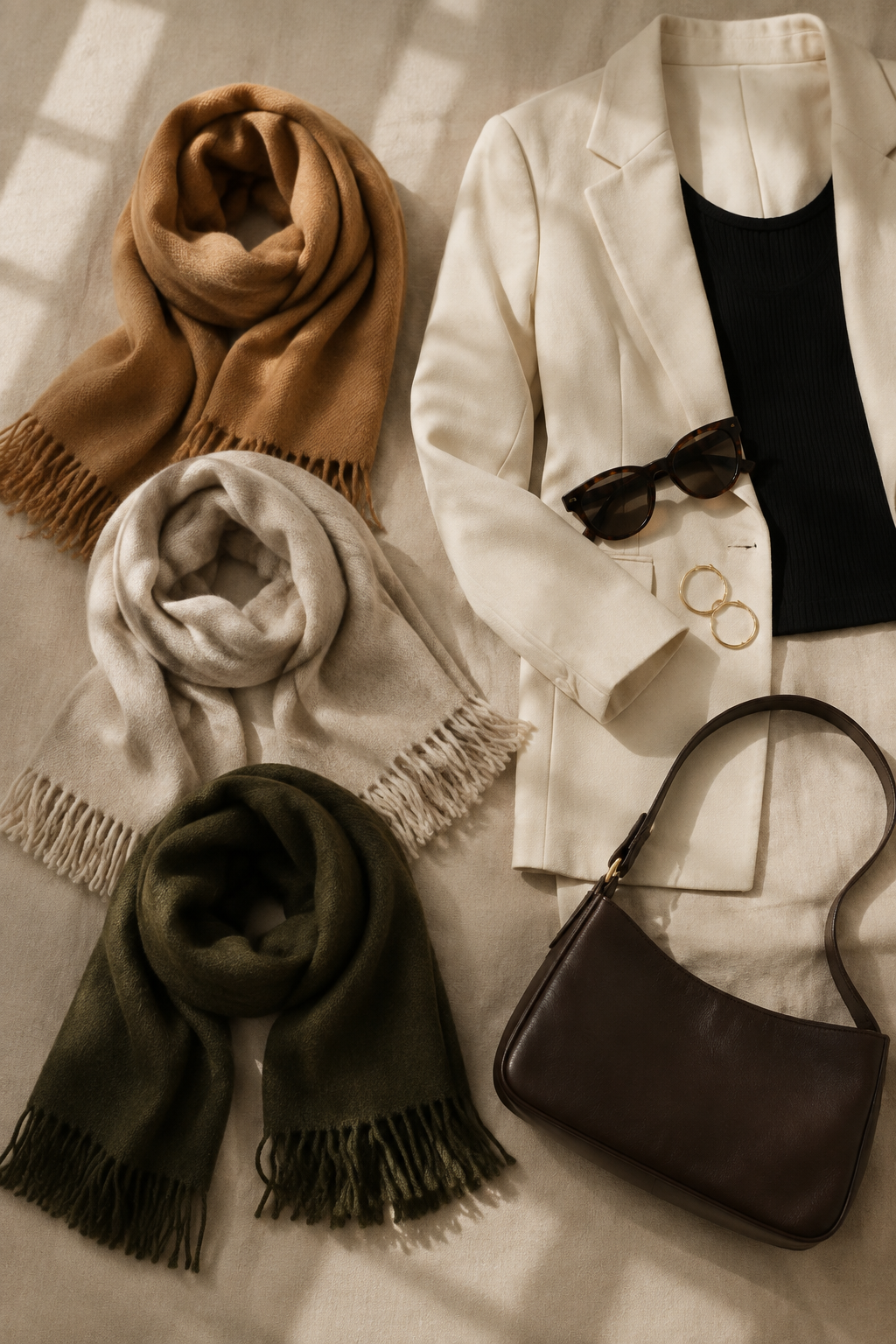
Because a scarf sits beside the face, color has immediate consequences. Camel brings warmth to olive skin and gives chestnut waves a tonal frame. Oatmeal is softer than bright white and brightens the complexion without creating a cold stripe. Deep olive draws out hazel-green eyes, while espresso gives black dresses and cream coats a richer transition.
Lila avoids beige that turns yellow and gray that turns blue. She studies product photos against white backgrounds and customer images in daylight, then checks whether the color already exists in a belt, bag, shoe, or coat. A scarf should connect the wardrobe rather than introduce a lonely new neutral.
If your closet is mostly black, start with camel or oatmeal for visible contrast. If it already contains cream, camel, and brown, deep olive creates dimension without breaking the quiet-luxury palette. Espresso is the strongest evening choice because it stays dark while treating warm skin more gently than hard black.
Wear one loose wrap with tailoring so the jacket still controls the silhouette
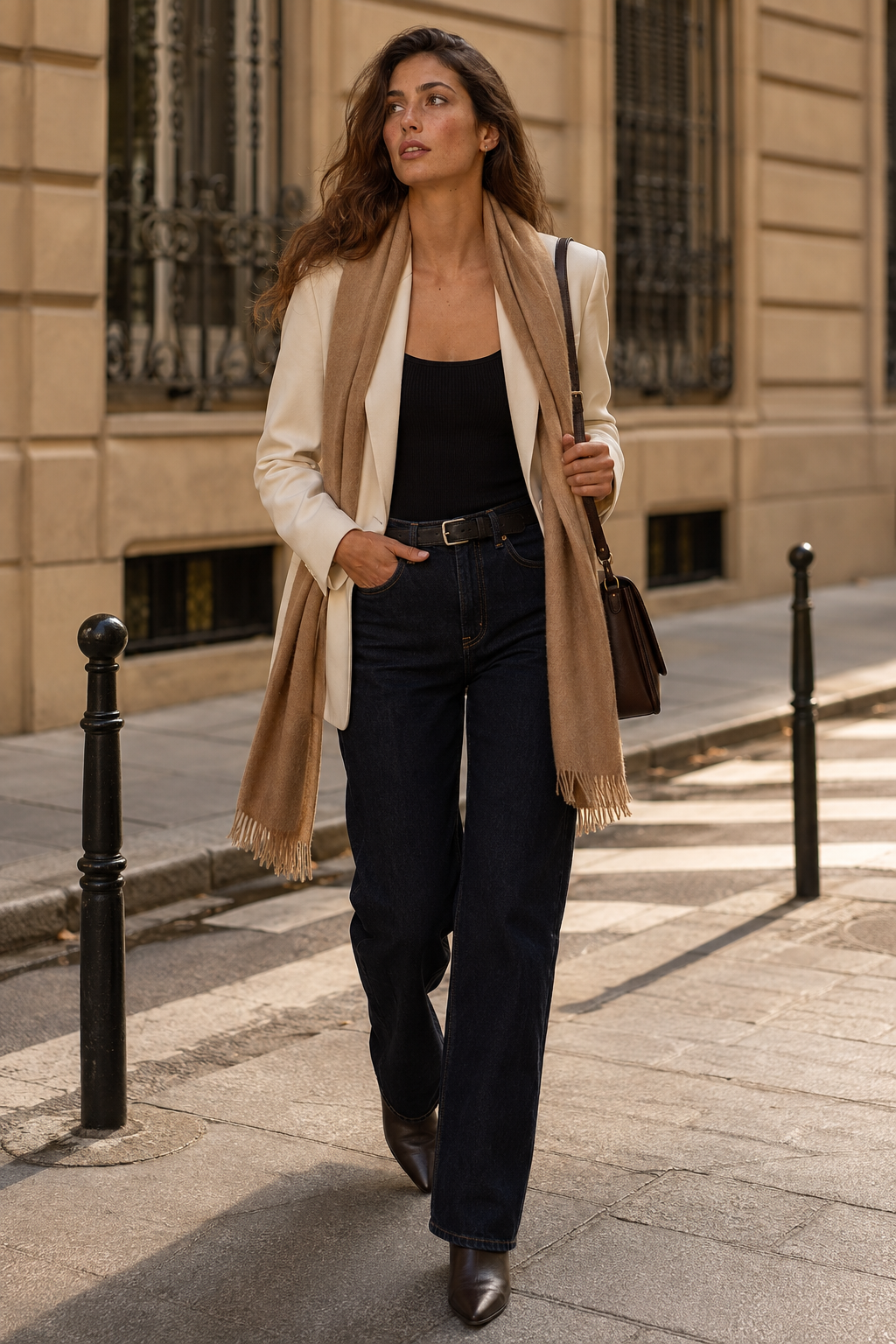
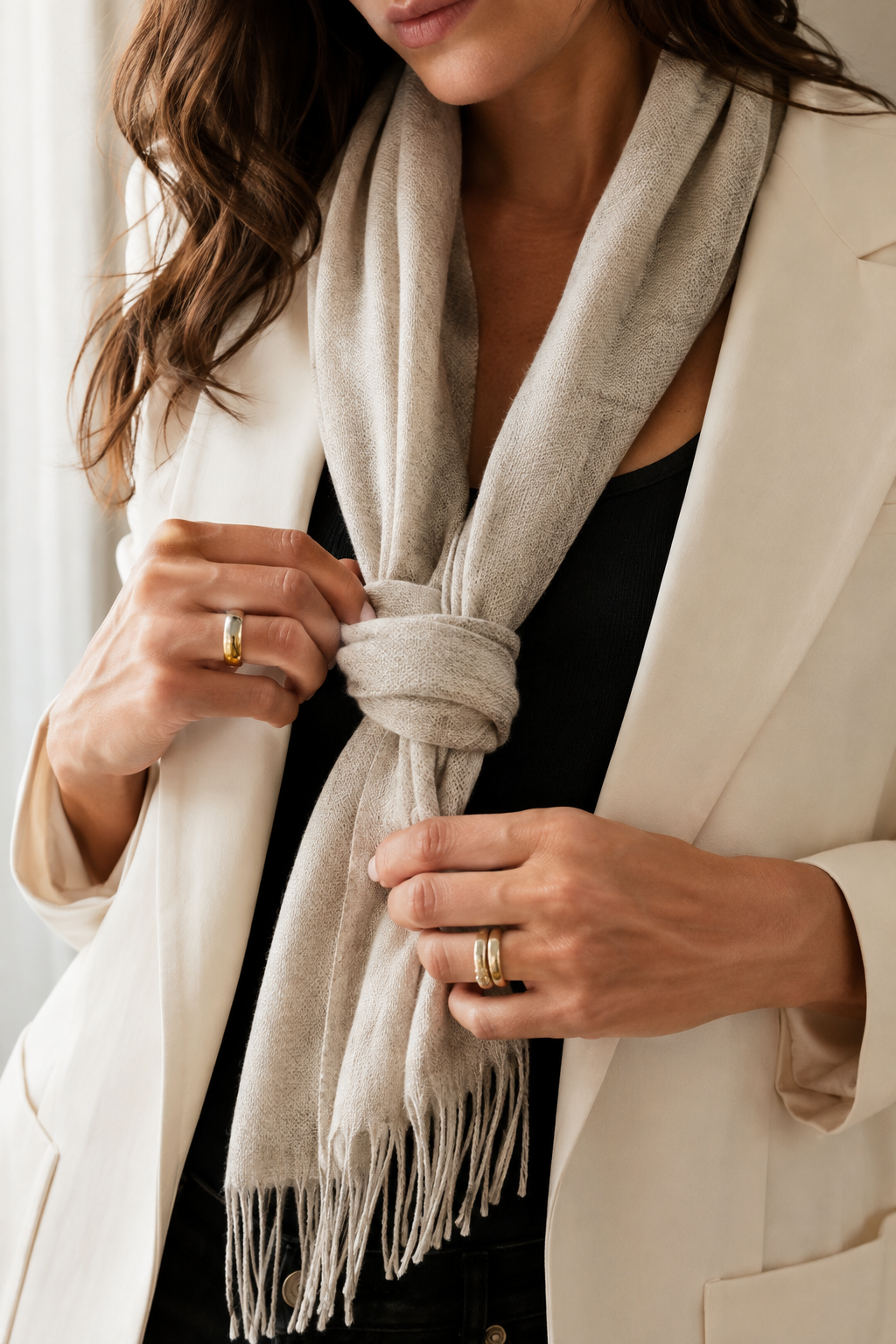
With tailoring, the scarf must follow the vertical line instead of covering it. Lila lays the center at the front of the neck, crosses the ends once behind, and lets them fall forward. The result frames a black tank, keeps the cream lapels visible, and adds movement without erasing the waist.
A Lightweight Wool Scarf in camel works especially well with a Cream Tailored Blazer, Ribbed Black Tank, and Straight-Leg Denim. The texture softens the jacket, while the dark column underneath keeps the body long. A Minimal Shoulder Bag repeats the warmth without adding another large shape near the torso.
Skip complicated knots for this outfit. Dense knots shorten the neck and compete with earrings, hair, and the blazer collar. On camera, a simple vertical drape makes the product easier to read and the entire outfit more expensive-looking.
Pack fine merino for flights because it adapts faster than a heavy knit
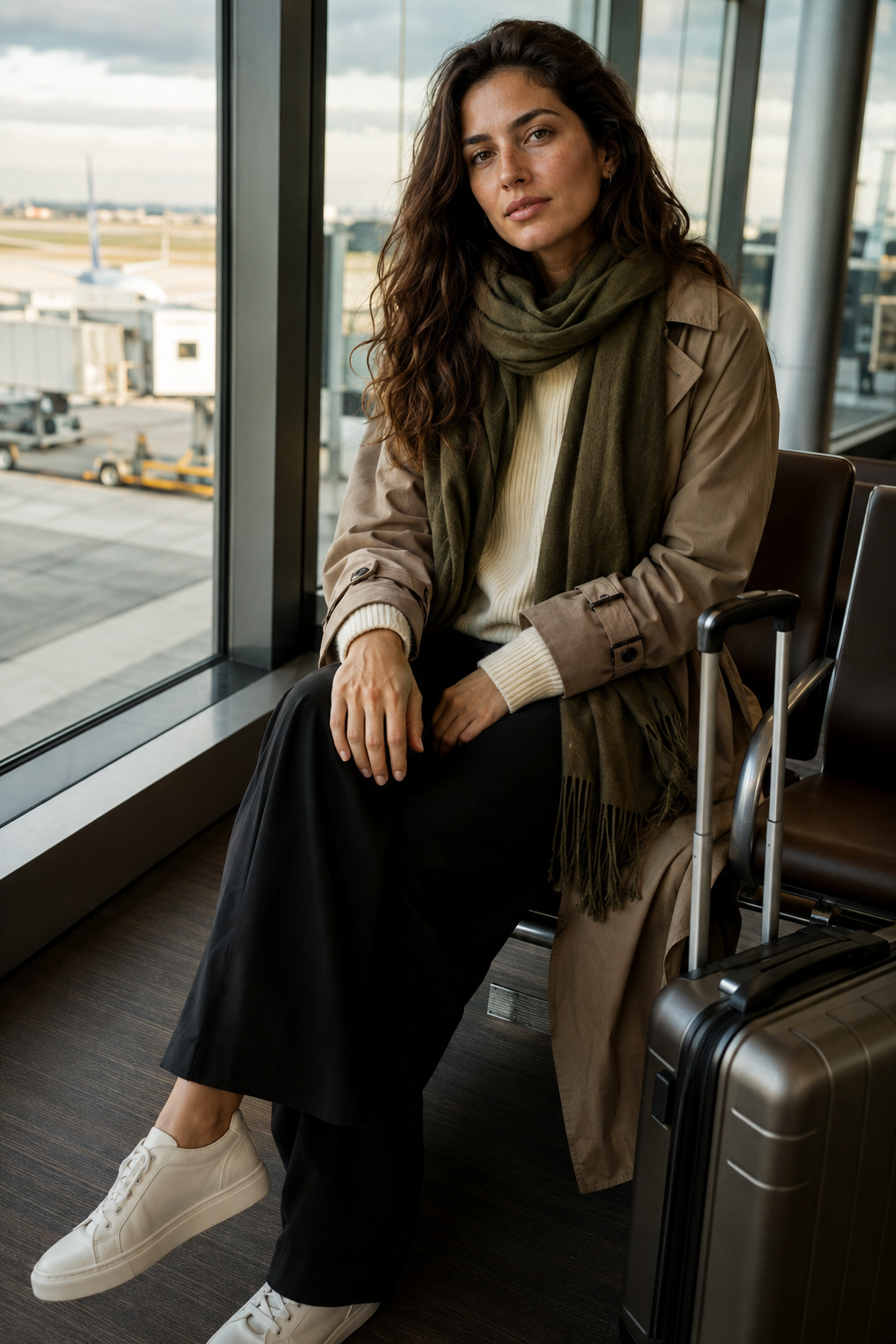
Airport temperatures are rarely stable. A Fine Merino Wool Scarf can cover the neck during boarding, open across the shoulders in a cold cabin, then fold into a tote after landing. Lila pairs deep olive with a trench, cream knit, black trousers, and minimal white sneakers so every piece survives both travel and the first meeting at the destination.
Merino is useful because it breathes and tends to recover its shape after being folded. Still, read care instructions before buying. A scarf that requires elaborate handling after every trip is less practical than one that can air overnight and return to the closet without losing its edge finish.
For packing, fold rather than roll a fringed scarf, then place it flat above clothing instead of under shoes or a cosmetic case. The goal is to arrive with a fluid rectangle, not deep compression lines that make the accessory look tired in photographs.
Treat an espresso cashmere-blend scarf like a narrow stole for dinner
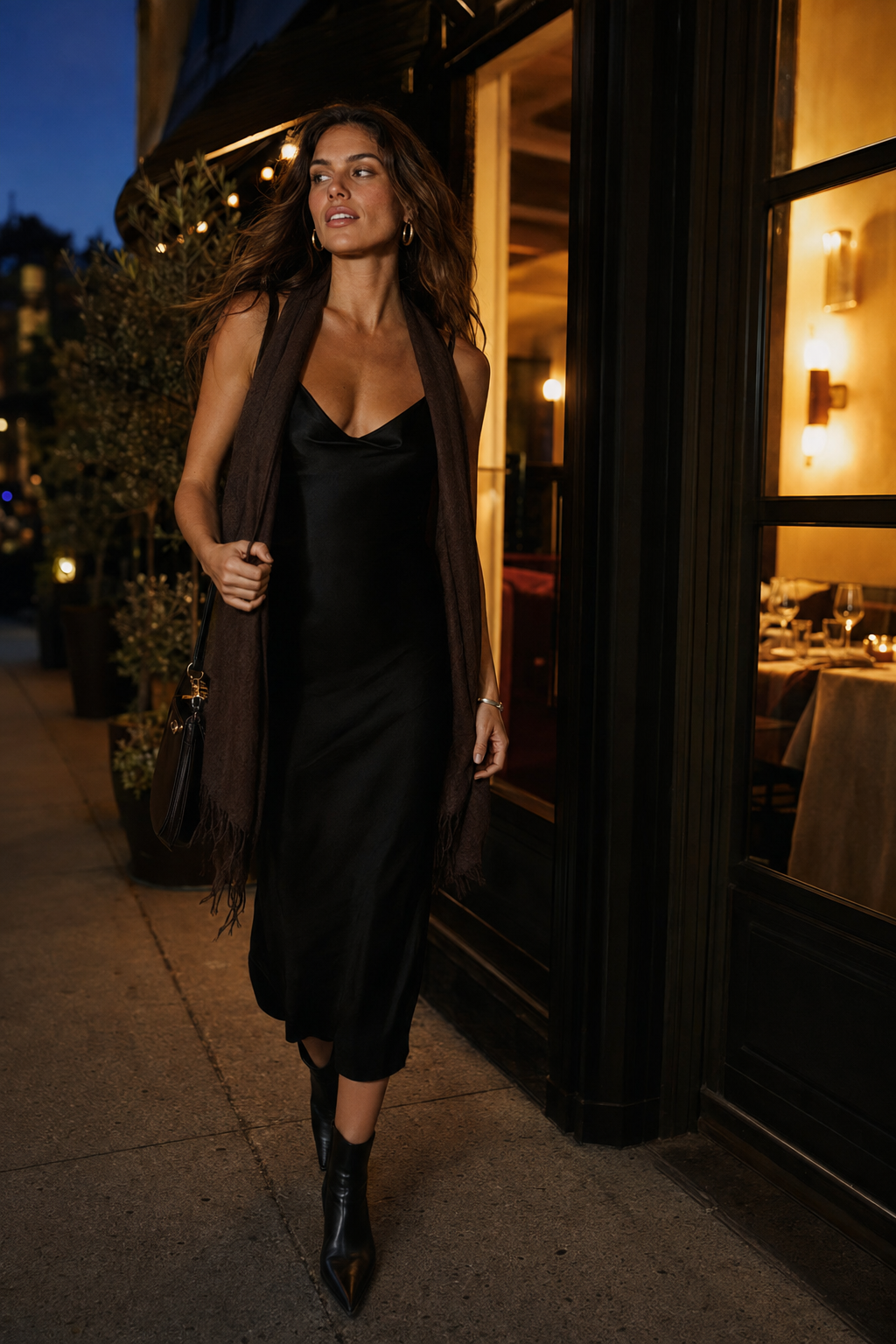
A Black Slip Midi Dress needs warmth that respects its movement. Lila lays a Lightweight Cashmere-Blend Scarf around the shoulders or lets it fall long at the front, then adds pointed boots, a compact shoulder bag, and warm gold hoops. The scarf should look intentional beside satin, not like outerwear forgotten at the table.
Espresso works because it creates depth without severing the dark line of the dress. The fine texture absorbs restaurant light while satin reflects it, giving the outfit a quiet contrast that reads well in person and on camera. If the scarf is wide, fold it lengthwise once so the dress neckline and shoulders remain visible.
This is also where softness has to be real. Dinner scarves touch bare shoulders and the front of the neck, so scratchiness becomes impossible to ignore. Check reviews for skin sensitivity and return policies before buying a wool blend for evening wear.
Check fiber, edges, pilling, and return terms before you buy
Start with the fiber label rather than the marketing name. A product described as cashmere-like may contain no cashmere, and a wool blend can range from genuinely warm to mostly synthetic. Lila accepts blends when the percentages are clear, the hand looks fluid, and the price reflects the actual material.
Next, zoom into the edges. Fine fringe should be even and firmly secured; a clean hem should lie flat rather than curl. Customer photos reveal whether the surface pills after a few wears or transfers lint onto black tailoring. Those details matter more than gift-box packaging because they determine repeat wear.
Finally, confirm the return window and name three outfits already in your closet. If the scarf works with your travel coat, weekday blazer, and one evening dress, it has a convincing role. The best lightweight wool scarf is not merely soft in the hand. It controls temperature, frames the face, packs flat, and keeps proving useful after September.